Your cosmic signature is the card CelestKin shows the moment you add your birth details: one value each from Vedic, Chinese, Mayan, Numerology and Human Design astrology, revealed a line at a time, and one of 24 archetype names picked from four of those values. Most of it is calculated on your phone, so the card appears without a wait.
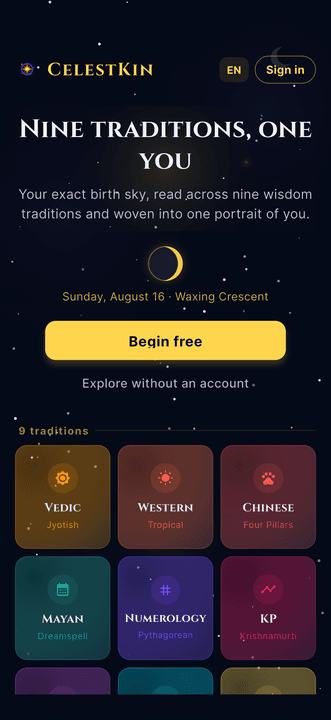
The first thing most astrology apps show you is a login wall, a quiz, or a paragraph about your Sun sign. The first thing CelestKin shows you is you. Add your birth details once, and before you've tapped anything else, five different traditions have already read you — and drawn their conclusions on the same screen.
We call it your cosmic signature: a single card that assembles itself in under two seconds, one line at a time, the moment your chart is ready.
Five Readings, One Card
Your signature isn't five copies of the same horoscope. It's five traditions' worth of technique, each computing from your exact birth details and each answering in its own language:
- Vedic — your sidereal moon sign, the seat of the emotional self in Jyotish.
- Chinese — your element and animal from the Four Pillars, the year you were born written as character; the same reckoning behind zodiac compatibility.
- Mayan — your galactic signature from the Dreamspell, a modern count built on the Maya 260-day Tzolk'in: a color and a solar seal.
- Numerology — your Life Path, distilled from the digits of your birth date.
- Human Design — your profile, the two-number role the system reads from where the Sun stood when you were born and where it stood about three months earlier.
Each is a real computed value, not a Sun-sign guess — and each arrives with its own colored spark, so at a glance you can see that five distinct systems, some centuries old and some from the last hundred years, from different parts of the world, are all describing one person: you.
One Birth Date, Worked Through
Three of the five rows need nothing but a date, and all three are easy to check by hand. Take someone born on 8 December 1993. Numerology reduces the month, the day and the year separately and keeps 11, 22 and 33 whole: 12 becomes 3, the 8 stays 8, and 1 + 9 + 9 + 3 = 22 stays a master number, so the Life Path is 3 + 8 + 22 = 33. The Chinese row reads a Water Rooster year. The Mayan row lands on Kin 19, Rhythmic Blue Storm, in the Dreamspell's 260-kin cycle, which takes its shape from the Maya count of 260 days built from the numbers 1 to 13 and 20 day signs.
The Vedic and Human Design rows need more than a date. A sidereal moon sign depends on the hour and place of birth, because the Moon circles Earth once every 27.3 days and so changes sign roughly every two and a quarter days. The Human Design row reads where the Sun stood at your birth time, and the Sun crosses about one line of a gate every day, so the hour can change the profile: for 8 December 1993 it reads 5/1 at midnight and 6/2 at noon, Universal Time. Strictly, the place matters too, because a local clock time has to be converted to Universal Time with the birth place's time zone. The app's Human Design screen uses that converted moment once our server has worked it out; this card, drawn the moment you add a profile, reads your local clock time as given, so for a birth near the edge of a line the two can show different profiles.
The Mayan row has an edge case of its own: it follows the Dreamspell count, which does not advance on 29 February, so it drifts a day from the classical Tzolk'in at every leap day. A 29 February birthday has no kin of its own in the Dreamspell, and the card reads 1 March's.
Is Your Signature Calculated on Your Phone?
Mostly, yes. Four of the five rows are calculated on your own phone — the arithmetic of the Four Pillars, the Dreamspell count (modelled on the Maya Tzolk'in), the numerology, the Human Design Sun gate all run on-device in a heartbeat. There is no spinner, no server round-trip standing between you and your first read. The deeper Vedic sky-math — the precise sidereal positions — comes from our server a moment behind, because the phone does not work out a Moon sign of its own, and the card fills in the Vedic row when it arrives. That happens on the card for your own profile, the one marked as you. On a card for anyone else you add, the Vedic row shows a dash.
The design principle is simple: value before friction. You should feel seen in the first few seconds, not after a sign-up funnel.
How Is the Archetype Name Chosen?
The archetype name is picked by a fixed calculation from four of your values: your Life Path, Human Design profile, Chinese animal and Mayan seal. The app joins them into one line of text and runs it through FNV-1a, a published non-cryptographic hash that gives the same number for the same text on every phone. That number picks one of 24 names, such as The Quiet Architect or The Slow Bloom. The line has a place for a Moon sign as well, but the phone works out no Moon sign, so that place is always empty and the Vedic row never changes the name.
At the bottom of the card, one more line lands last — an archetype. Not a label pulled from a hat, but a single evocative name drawn from the pattern across four of the traditions at once: the way your Life Path meets your Human Design profile meets your animal meets your Mayan seal.
The archetype is deterministic on purpose. The same four values always resolve to the same name — so it reads as identity, something that's true of you, rather than a horoscope that resets every morning. It's also made to keep: a quiet, dark-gold card you can screenshot and send to a friend when they ask, “so what are you?”
Names have moved once, and the cause was a correction on our side. Before a fix we made in late September 2026, the card cast Human Design at noon rather than at your birth time, and its profile repeated the first number as the second (1/1 through 6/6), none of which is a profile Human Design has: the second number belongs to the Sun 88 degrees earlier in its path, about three months before birth. The profile is one of the four inputs, so the corrected card gives almost everyone who saw a name before a different one.
Twenty-four names spread over 34,560 possible combinations of those four values (12 Life Paths, 12 profiles, 12 animals and 20 seals), so every name is shared by many people. The archetype places you in a family of patterns; the five rows above it are what make the card yours.
A Mirror, Not a Verdict
A signature is a beginning, not a sentence. Nothing here decides your future or hands down a grade — it offers a vocabulary for noticing patterns you may already half-know, and a starting point for the deeper readings if you want to go further — the full picture is what nine traditions in one reading is for. You hold the pen; the chart is only ever a mirror you choose how to read.
CelestKin speaks eleven languages, your readings stay yours, and there's no streak guilt or notification spam waiting on the other side. Just you, read honestly, in the first ten seconds.
Find out which archetype you get
Add your birth date, time and place, and the card fills its five rows and names your archetype before you tap anything else.