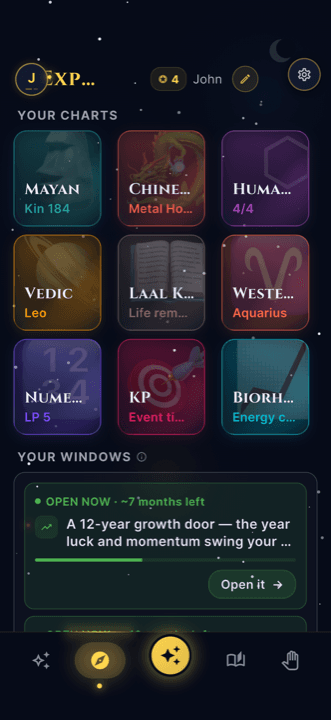
CelestKin's nine-tradition reading is one set of birth details computed nine ways: Vedic, KP, Laal Kitab, Western, Chinese Four Pillars, Mayan, Numerology, Human Design and Biorhythm. The app reads them together because each system measures something different, and when two systems built on different mathematics point the same way, that agreement tells you more than either chart does alone.
For most of history, where you were born decided which sky you got. Born in Varanasi, you got Jyotish. In Chang'an, the Four Pillars. In the Yucatán, the sacred count of days. Each civilization spent centuries refining its own answer to the same question: what does this birth mean?
You don't have to pick one. From a single set of birth details CelestKin works out a chart in each of the nine, then lays them next to each other to show where they line up and where they pull apart.
What does each of the nine traditions measure?
Each of the nine traditions measures a different part of the same birth, and Vedic astrology is the one built for timing. Its dasha periods segment your life into planetary chapters: the Vimshottari system, which a classical Vedic astrology text sets out as a 120-year cycle, gives each of nine planets a period of 6 to 20 years, starting from the nakshatra your Moon occupied at birth. Western astrology maps psychology and motivation. The Four Pillars weigh your elemental balance. Numerology hears the pattern in your name and numbers. Human Design tells you how to decide, not what. Biorhythm tracks the body's own tides.
The remaining three narrow or reframe what the others see. KP (Krishnamurti Paddhati) splits the Vedic zodiac into sub-lords to sharpen timing questions. Laal Kitab takes the Vedic chart and turns it into small, practical remedies. The Mayan section places your birth day in the Tzolk'in, which the Smithsonian's National Museum of the American Indian describes as 20 day signs combined with the numbers 1 to 13, giving 260 unique days. The app shows that classical count and the modern Dreamspell kin under separate labels, because the two give a different name to every date since 1900.
Ask one system everything and you get its blind spots for free. Ask nine, and the blind spots start covering for each other.
Why the same birth gives different signs
The same birth can give two different signs because the traditions do not share one zodiac. Western astrology counts from the Sun's position at the March equinox, the tropical zodiac; Vedic astrology counts from the stars, the sidereal zodiac. The Swiss Ephemeris documentation, for the library our server uses to place the planets, puts the drift between the two at 1° every 71.6 years, now more than 20°, and notes that astrologers in the Indian tradition mostly use the Lahiri correction. That is the correction CelestKin's Vedic chart applies.
Consider one birth: 9:30 am on 10 April 1994 in Toronto. The Western chart puts the Sun at 20° Aries, the Moon at 15° Aries and Gemini rising. The Vedic chart subtracts that year's Lahiri value of 23.8° and puts the same Sun at 26° Pisces, the Moon at 21° Pisces in the nakshatra Revati, and Taurus rising. KP applies Krishnamurti's correction, about 6 arcminutes smaller, and divides the houses by the Placidus method instead of the Vedic chart's whole signs. The Chinese chart files the year under the Wood Dog, and numerology reduces the date to Life Path 1 (1 + 0 + 0 + 4 + 1 + 9 + 9 + 4 = 28, then 2 + 8 = 10, then 1 + 0 = 1).
Neither Sun sign is a mistake; the two zodiacs measure from different starting points. With a gap of about 24°, only a Sun in the last 6° of a tropical sign stays in the same sign in the Vedic chart, so for roughly four birthdays in five the Western and Vedic Sun signs differ. CelestKin keeps both, each under its own tradition, rather than picking one.
Consensus Is a Signal. So Is Disagreement.
When three unrelated traditions — developed continents apart, with different mathematics — converge on the same read of your situation, that agreement carries weight a single horoscope never could. CelestKin's readings surface exactly that: where your nine charts agree, and where they pull in different directions.
The disagreements are honest, too. A reading that says "Vedic sees a demanding season; your numerology year says expansion — here's how both can be true" respects you more than one that averages the tension away. Real people contain tensions. So should their readings.
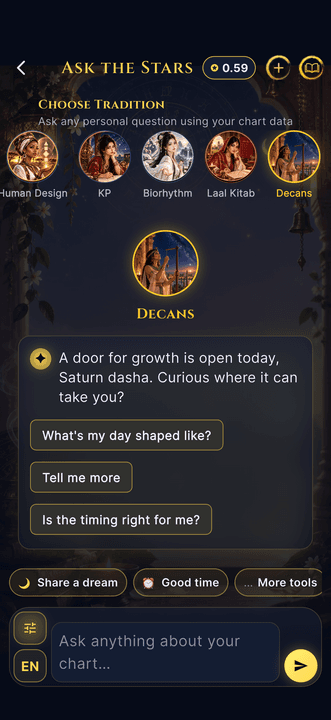
In Ask the Stars, the chat, a similar rule decides who speaks. A guide whose tradition does not own your question hands it, inside the same reply, to the guide whose tradition does. At most two guides answer an ordinary question; a broad one such as "what does my year look like?" can bring in three, each adding one thing the others cannot see.
What This Looks Like Day to Day
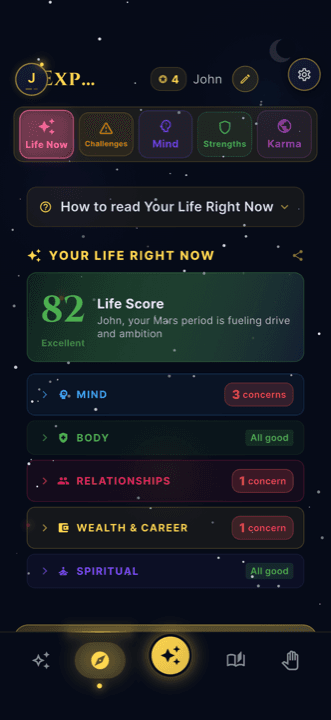
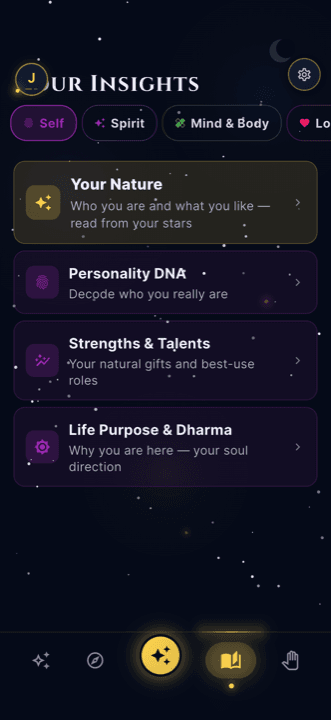
In practice, the nine traditions don't arrive as homework — they arrive as one coherent voice. Your daily guidance quietly draws on whichever systems speak to the day. Your deep insights pick the traditions best suited to each life area. You can always open the hood and see any individual chart, but you never have to.
The 14-Day Forecast shows the blend in numbers. Its love, career, health and growth scores take inputs from the Vedic period you are in, KP sub-lords, Laal Kitab, the Chinese year, your numerology year and day, and your biorhythm cycles, plus the Moon's phase. Not every screen uses all nine. On the Daily Edition in Explore, the Nature and Temperament cards are read from the Vedic chart alone. Mind & Calling opens with a reading of the Vedic chart, then adds mind states drawn from the Vedic chart, Human Design, the Mayan chart, numerology and Laal Kitab.
Which traditions need your birth time?
Vedic, KP, Laal Kitab, Western and Human Design need your birth time, and the Chinese chart needs it for its hour pillar; Numerology, the Mayan count and Biorhythm never use it. The rising sign moves through all twelve signs in about a day, roughly one degree every four minutes, and the houses move with it. Human Design places each planet in one of 64 gates of 5.625°, and the Moon crosses a gate in under half a day.
If you leave the time blank, the app computes the time-dependent charts for 12:00 noon. The date-only results stay exact; the rising sign and houses become placeholders, and so do the dates of your Vedic periods, which are counted from the Moon's exact position at birth. The Moon moves about 13° a day, so a noon guess can move those dates by years. If a recorded time exists anywhere, it is worth tracking down before you read much into your houses.
One You
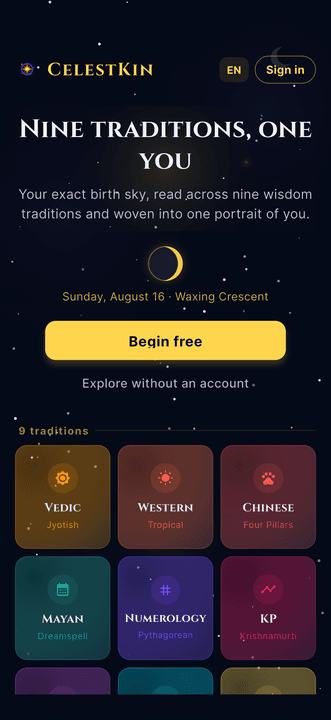
The app's name for this is the same phrase on its welcome screen: nine traditions, one you. The traditions are instruments; you're the music. Every reading is built from the birth details you entered, rendered in your language, and written under one rule — describe the sky honestly, and leave the steering wheel in your hands.
All nine from one birth entry
The app works out all nine charts from one birth entry, opens each one on its own, and gives each tradition a guide in chat.