Ask the Stars is CelestKin's chat, where you type a question about your own life and get an answer read from your birth charts. You can pick one tradition's guide, such as Vedic, Chinese or Human Design, or leave the choice open, and each reply is written to lead with the answer, with dates first when you ask "when".
Nobody lies awake at 2am wondering about "Mars in the 10th house." They wonder: should I take the offer? Is this relationship going somewhere? When do I make the move? Ask the Stars exists for exactly those questions — asked in your own words, answered from your own chart.
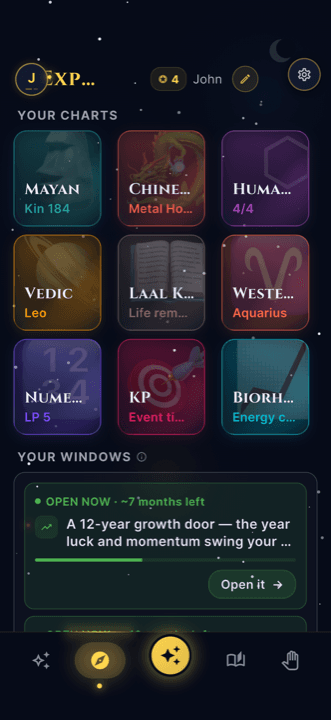
Type the question the way you'd ask a trusted friend. The reply is written with your own charts in front of it: Vedic, Western, Chinese, Mayan, numerology, Human Design, biorhythm and Laal Kitab, plus the KP chart when you ask the KP guide, all worked out from the birth details you entered. It is not the sun-sign paragraph every other reader of your sign got this morning.
Answers With Addresses
An answer cites its sources in your chart: the dasha period you're running, the house the question lives in, the transit that makes this month different from last month. Ask about career and it reads your 10th house and your current planetary period together. Ask about timing and it gets specific — windows, not vibes.
The house meanings come from the classical texts rather than from us. A classical Vedic astrology text reads profession and honour from the 10th house, marriage and trade from the 7th, and lands and houses from the 4th, and it sets the Vimshottari planetary periods over a 120-year cycle. The positions those rules are applied to are computed on our server with the Swiss Ephemeris, by the same code that serves the app's chart calculations.
And because it's a conversation, you can push back. "What if I wait a year?" "What about the other offer?" The thread remembers your chart and your previous questions, so follow-ups build instead of starting over. As a thread grows, older turns are folded into a summary and the facts you have shared, such as an offer, a date or a name, are kept in a running list, so a question on day ten can still lean on day one. The full text of every message is stored encrypted. Beside each message you send, the first 120 characters are also kept as plain text, so a short question is stored whole without that encryption, and the same goes for the start of a reply saved after you left before it finished. The thread's title, its running summary and that fact list are stored with the thread without that encryption too, and a thread with no title takes one from the opening words of your first message.
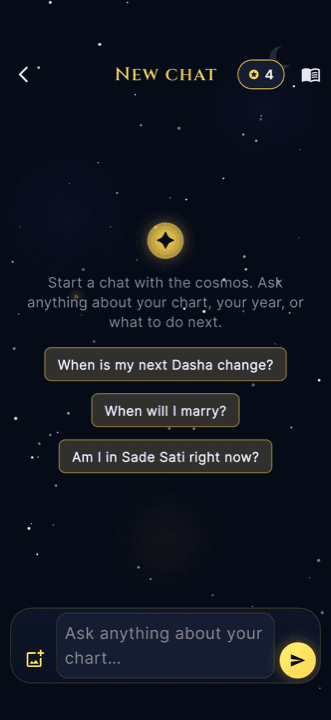
Which tradition answers your question?
The tradition that owns the question answers it. Pick a guide and every reply comes in that tradition's voice; if your question belongs to another system, your guide says so and hands it to that system's guide inside the same reply. Leave the guide unset and the reply draws on whichever tradition fits the question. At most two guides speak on an ordinary question, and a broad one such as "what does my year look like?" can bring in three, each saying one thing the others can't.
The guide row above the message box holds ten guides: Vedic, Chinese, Numerology, Mayan, Western, Human Design, KP, Biorhythm, Laal Kitab and the Egyptian decans, a 36-part division of the Western Sun. Readers in Korea, or anyone using the app in Korean, see Saju (사주) where Chinese stands, because the two read the same four pillars and showing both would offer one reading twice.
A single-tradition reading is one advisor's opinion. Ask the Stars has the full bench on hand: Vedic timing, Western psychology, Chinese elemental balance, numerological year cycles, Human Design strategy. When the traditions agree, you'll know — that consensus is worth something. When they disagree, you'll see the tension honestly instead of a false average.
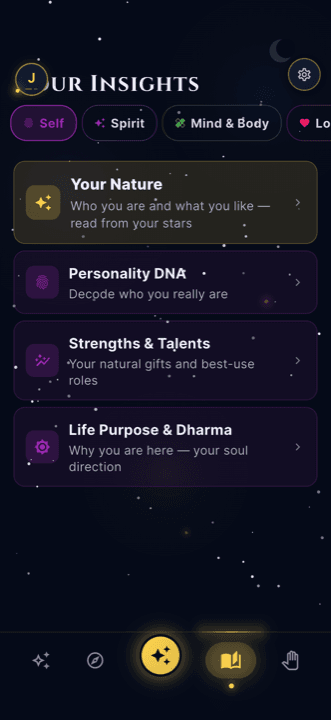
For questions that deserve more than a chat reply, the Insights library goes deeper — full readings on love, career, wealth, health and twenty other topics, 24 in all, each drawing on whichever traditions fit that topic. On the web, the birth chart tool gives your Sun sign, element, modality and decan from a birth date, and the other free calculators let you check a single placement without opening a thread at all.
Honest About What It Is
Ask the Stars won't pretend to decide for you, and it won't manufacture doom to keep you asking. The house rules are strict: the chart describes conditions and patterns; the decisions stay yours. It's a reflection instrument with an extraordinary memory for your sky — treat it like the wise friend who happens to have your chart open, not an oracle that replaces your judgment. Our methodology page sets out exactly which calculations sit behind an answer and where the reasoning stops.
Some questions get a narrower answer on purpose. Ask whether someone else loves you and the reply speaks to the relationship, not to the other person's feelings, because the app holds no chart for them. When a guide's chart data doesn't cover what you asked, the guide says so in a line and names what would settle it, rather than inventing a degree or a date.
A message that reads as a crisis gets no reading at all. The chat replies with helpline numbers for the country your phone's time zone and language point to, from a list of 26 countries plus an international directory, and charges nothing for that message. In India, for example, that is the government's Tele-MANAS line, 14416 or 1-800-891-4416.
A normal reply spends credits from your balance, and a longer or more detailed answer costs more than a short one. The chat says this once, on your first chat, and nothing is taken for a reply that never arrives. The Answer length control lets you choose TL;DR, Default or Detailed before you send.
Put your question to a guide
Pick the tradition that suits your question, ask it in your own words, and choose TL;DR, Default or Detailed for the answer.