Your Vedic chart screen, read line by line
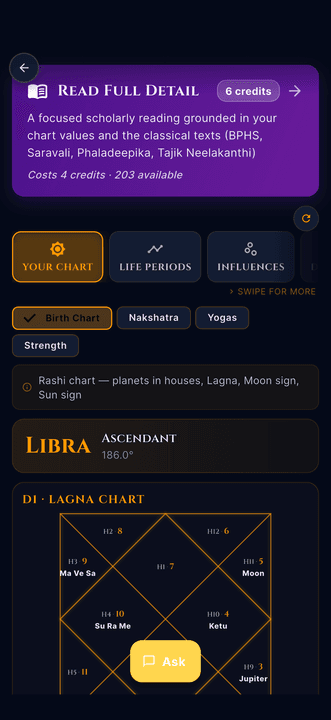
The Vedic chart in CelestKin is your D1 Lagna chart: a North-Indian diamond whose top cell is your Ascendant (house 1), with the houses running counter-clockwise and the number in each cell naming the sign that occupies that house. Under it, every planet card gives the planet's sign, degree and house in plain words.
A kundli can feel like a locked diagram: a diamond of numbers, two-letter planet codes, and abbreviations nobody explains. CelestKin computes the real thing (Lahiri ayanamsa, actual ephemeris data), and then does what most apps skip: it explains every value on the screen where you see it.
What do the numbers in the Vedic chart mean?
Each cell carries two numbers: a small H-number, which is the house, and a larger number, which is the sign in that house, counted from 1 for Aries to 12 for Pisces.
The diamond is the North-Indian style chart. Your Ascendant (Lagna) sits at the top; the H-numbers mark the twelve houses counted counter-clockwise, and the number inside each cell is the sign (rashi) occupying that house. The legend under the chart spells out the convention, so you never have to guess whether a cell number means house or sign again.
A worked example makes the convention concrete. Take a chart with Sagittarius rising and the Moon at 15° Libra. The top cell is H1 and shows 9, because Sagittarius is the ninth sign. Counting counter-clockwise, H2 shows 10 for Capricorn, H3 shows 11, and so on round to H11, which shows 7 for Libra. The Moon is drawn in that H11 cell, and its card carries the H11 badge. The two numbers disagree on purpose: 7 is where the Moon is in the zodiac, 11 is where it falls in your life.
Houses here are whole signs: the rising sign fills house 1 from 0° to 30°, the next sign is house 2, and so on. The Swiss Ephemeris documentation describes whole-sign houses as a method still used in Hindu astrology, and the Swiss Ephemeris library is what computes this chart on our servers.
Every planet card teaches its own placement
Under the chart, each planet gets a card with its classical sigil, its sign and exact degree, its house badge, and, this is the part we care most about, three short lines of plain language: what the planet carries ("Vitality and purpose" for the Sun), how its sign colors it ("Libra: balanced and fair"), and what its house governs ("House 11: gains and friendships"). No value on the screen is left unexplained; that is a product rule, not a marketing line.
The ℞ mark means retrograde motion. Rahu and Ketu, the lunar nodes, carry their own sigils and their own themes: ambition and obsession for Rahu, detachment and release for Ketu.
Why is my Vedic sign different from my Western sign?
The Vedic chart is sidereal: it subtracts an offset called the ayanamsa, about 24° today, from the tropical positions a Western chart uses. Any planet in the first 24° of a tropical sign therefore moves back one sign, which works out to about four placements in five.
The Ayanamsa tile on the screen shows that offset at your birth moment, to two decimals. CelestKin uses the Lahiri ayanamsa, which India's Calendar Reform Committee fixed at 23°15′ on 21 March 1956, growing by about 50.27 arcseconds a year after that (the committee's report). The growth comes from axial precession, the slow wobble of Earth's axis that NASA puts at about 25,771.5 years per cycle. For a birth on 1 January 2000 the tile reads about 23.86°; for a birth in January 2026, about 24.22°.
Deeper floors: dashas, nakshatras, divisional charts
The same screen carries your current Mahadasha with its years remaining, your Moon nakshatra and pada, and sixteen divisional charts from D1 to D60, each labeled with what it examines: wealth, siblings, children, career, past life. Sixteen is the classical count: chapter 6 of a classical Vedic astrology text is titled "The Sixteen Divisions of a Sign". When you want the scholarly read, one tap sends your exact chart values to a focused reading grounded in the classical texts.
The Mahadasha follows from the Moon's nakshatra. In the example chart, the Moon at 15° Libra sits in Swati, which runs from 6°40′ to 20°00′ Libra, and in its third pada, since each pada is 3°20′ wide; the screen shows it as Swati · P3. Swati's period belongs to Rahu and lasts 18 years. The Moon has already crossed 62.5% of Swati, so 37.5% of those 18 years, or 6.75 years of Rahu, remained at birth. Jupiter (16 years), Saturn (19) and Mercury (17) come next, and the nine periods add up to 120 years.
If you have ever been told your rashi comes from the first letter of your name, the chart screen will also gently correct that: your true rashi is set by the Moon at your birth moment. Read more about how the nine traditions fit together in Nine Traditions, One Reading.
Birth time: the input that moves this chart most
The rising sign needs the most accurate birth time. The Ascendant passes through all twelve signs in about 24 hours, roughly two hours per sign on average, so a time that is 20 minutes off moves the rising degree by about 5°. Mid-sign, the house numbers stay the same; near a sign boundary, the rising sign changes, and with it every house number on the chart.
The Moon is more forgiving, except about dates. The Moon moves about 13° a day, a little over half a degree an hour, so it needs about six hours to cross one 3°20′ pada; an hour's error changes the pada only if the Moon sat within about half a degree of a boundary. The dasha dates are more sensitive: in the Swati example, half a degree of Moon is about 4% of the nakshatra, which moves the start and end of every period by roughly eight months. Rahu and Ketu, finally, are placed by the mean node, the traditional choice, which can differ from the true node by up to about one and a half degrees.
Your D1 chart, explained cell by cell
The app computes your sidereal chart with the Lahiri ayanamsa, your Vimshottari periods and sixteen divisional charts, and labels each value where it appears.

Get a weekly dose of multi-tradition astrology
One email per week. Psychology-informed reflections, not horoscope fluff. Unsubscribe anytime.
By subscribing you agree to our privacy policy. Unsubscribe any time.